
Caring
for your Limited Edition Prints For fine art
restoration, gilding, disaster recovery and damage limitation,
BACK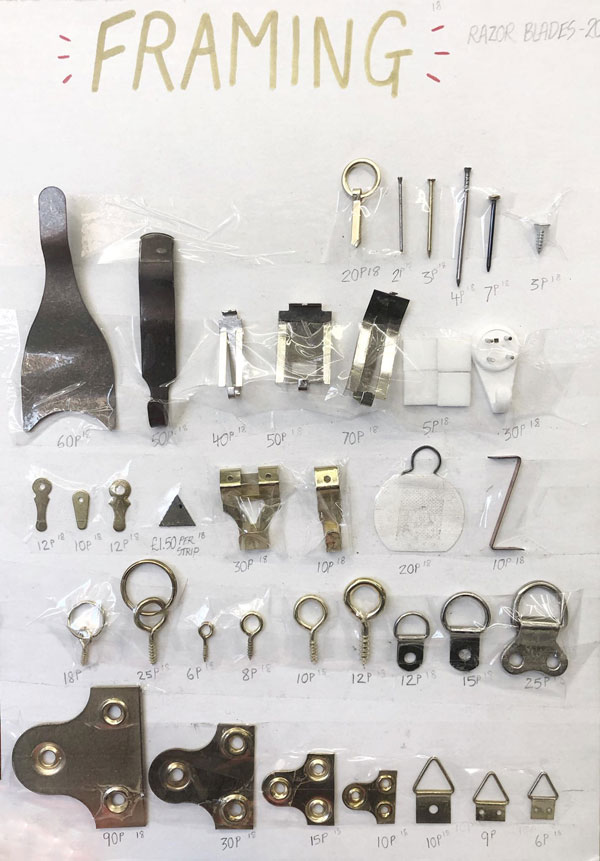
Picture framing items in Lancaster shop
Screw rings, Glass Plates, Picture Hooks, D rings
Masking and picture backing tapes
Gold Leaf paint and wax touch up

Treasure Liquid Leaf in bottle or wax form
Storage
Never store prints without mounts
directly one
on top of the other, unless they have been
separated by an acid-free tissue. Ideally your
prints should be kept in their individual folios
with an acid-free tissue on either side of the
print, or mount your prints and use an acid-
free tissue on top.
Never store or leave prints flat on the floor.
Keep them elevated so that air can circulate
underneath and around them.
If you have an option of wooden or metal
shelving, it is better to opt for wooden shelves, as metal tends to
cause condensation of water over a period of time. Metal is also a
greater conductor of heat in the case of a fire.
Clean framed prints that are kept in storage,
on a regular basis, as dust contains air borne
mould spores that can cause deterioration of
the print.
Handling
Always have clean hands, as natural body
oils can do permanent
damage to the paper.
Always use two hands to lift the paper so that
the edges do not get crimped.
Never touch or drag anything across the image area, particularly if
it is silk screened. If you leave a thumb print or scratch the
surface, you will leave a permanent mark
that cannot be repaired.
Never use pressure sensitive tapes on the
paper.
Heat
Never hang to store prints or
paintings over or
next to a radiator or heater.
Never hang a piece of art over a fireplace as
the combination of heat, soot and smoke can
do extensive damage in a very short period of
time.
Humidity
Humidity is a major enemy to paper
and prints.
The chief danger in humidity is mould. Mould
grows in excess of seventy percent relative to
humidity.
According to museum curators, fifty percent humidity is ideally suited for keeping
fine works of art on paper. Always maintain proper humidity levels wherever prints
are being stored or hung.
Never frame directly on glass. If your prints
have not been mounted it invites
condensation to form which will ultimately
destroy the print.
Always ensure that there is air circulation
behind your print.
Make sure you check for dampness on any
outer wall where you are hanging your prints.
If there is a lot of water, moisture it will seep
through and into your prints.
Never hang prints or store them in damp
basements or cellars.
Light
All light fades works of art on paper. Fading
cannot be stopped by keeping your art in
subdued light. Less light means less fading.
Fading is not reversible. Taking art out of
direct light and putting it into a cupboard will
not restore the colour.
How much light is the optimum?
The measurement in terms of lighting is
called foot-candles, and according to the
Museum of Fine Arts in Boston, the optimum
is five foot-candles, which is roughly
equivalent of a 150 watt bulb, approximately
four to five feet away from the piece that is
being lighted.
Avoid hanging or placing your art opposite a
window.
Never place your art in direct sunlight.
Avoid reflecting light as it has ultra-violet rays
that can be very harmful to inks and paper.
Fluorescent lights are probably the most
potent source of ultra-violet rays, and if you
do have fluorescent light over a painting, or
even in a room where you have prints or
watercolours hanging, you should have them
covered with a special cylindrical sleeve to
help cut down on the ultra-violet rays.
Plexiglas is the best filter for ultra-violet rays,
and will give your print the longest life
expectancy.
visit Richard Zahler's web site for further information and contact details.
Rapid response specialist with a repertoire of prestigious clients.
CLICK HERE

Discount Art Craft and Graphic Materials from StudioArtshop.co.uk

50 North Road
Lancaster England LA1 1LT
Tel: +44 (0)1524 68014
Copyright © Studio Arts. All Rights
Reserved.