

Gouache Paint information, hints and tips
Winsor & Newton Hints and
Tips Designer Gouache

Click Here to Buy Designer Gouache with Online Discounts
| Designer Gouache Winsor & Newton | |||
|
The History - Winsor & Newton Gouache is both a technique and a product. The technique, dating back to before the renaissance, refers to the use of white to achieve opacity in water based colours. Originally used for illuminating manuscripts, it was Paul Sandby in the 18th century who first used the painting technique extensively and later the Pre-Raphaelites. Opaque techniques were further popularised by the Impressionists and Post-Impressionists, in their use of pastel, lithography and wood cuts. Gouache, the product, was a result of this interest in both opaque and water based products. Poster colour appeared after the first world war and this was significantly improved upon with the introduction of Designers Opaque Water Colour in the 1930 . Technique vs. Product The technique of adding white is known as body colour. You can do this with acrylic or water colour. Although with some colours you will get the effect of brilliance with the addition of white, you will be severely limited in subsequent colour mixing as a result of the colours being tints. The best gouache is not manufactured by adding white but by using an extremely high level of pigmentation. This leaves the artist free to add white themselves or colour mix as they expect in other media. Cheaper gouache colours are made opaque by the addition of white extenders and this will affect your colour mixing too. Other types of gouache: as a result of this long history, gouache has in some cases become a general term, used for any product which is opaque and matt. This can be anything from childrens paints to acrylic ranges. Traditional gouache is made from gum arabic. Gum arabic produces a flow which handles better than acrylic but it is not water resistant. Acrylic gouache is water resistant but does not having the expected handling properties. |
Click Here for Designers
Gouache 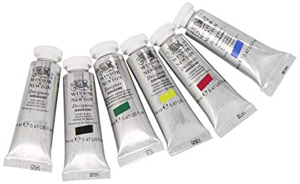 |
||
| Who Uses Gouache and Why?
Click Here to Buy Designer Gouache with Online Discounts Designers its ease of use and brilliance make it the most popular designers colour, hence the name, Designers Gouache. The matt finish makes for more accurate reproduction at artwork stage. Fine artists use it in conjunction with water colour or on its own. Its brilliance and opacity give it solidity, excellent for abstract work. Strong effects also result from the contrast of working on coloured backgrounds which are left partly exposed. Airbrushing water based and great covering power make gouache popular with airbrush artists. It is the high pigmentation which makes the gouache opaque and matt. Calligraphy gouache is used by calligraphers because of its excellent flow, opacity and permanence. Marbling the high pigmentation and gum arabic base make it a common choice with professional marblers. What To Use It On Best results are achieved on paper. For flat artwork, use HP water colour paper or smooth cartridge paper. Use 140lb or 220g to reduce cockling, or better still stretch the paper first. Cockling is likely to be worse if you leave some of the paper unpainted. Pastel paper will give you the strongest coloured background but these papers are not generally as lightfast as artists colours. Try tinted water colour paper instead or colouring stretched paper yourself with gouache first. Permanence Permanence in the main refers to lightfastness. Some of the most vivid pinks and violets are only moderately durable, more suitable for designers artwork than fine artists who want greater permanence. The latter should choose only the colours rated as permanent. Do not mistake any references to permanence on lower quality products if the meaning is waterproof. Making Gouache Waterproof Gouache can be made water resistant by mixing with acrylic medium. If you want to do this because colour is dusting off, see below. The more medium you add, the deeper the tone will become and you will reduce the characteristic matt gouache finish. Some gouache colours can react, the pinks and violets may change colour on mixing with the medium whist other colours may produce lumpy or gelatinous mixtures. Both these effects occur at the point of mixing on the palette. Preventing Gouache From Cracking Or Dusting Off The high pigmentation of gouache leaves the minimum room for binder. If painting in multiple layers the binder may be absorbed by underlayers, resulting in cracking. Dusting off can occur if the colour is diluted with too much water, leaving only pigment on the paper. This is common when airbrushing. In both cases you need gum arabic. With multiple layers, add gum arabic to the colour, keep it to a minimum or you will get transparency and gloss, but the amount needed will vary from colour to colour. For airbrushing, dilute all the colours with a mixture of gum arabic and water. Adding Texture Gouache is likely to crack if used in thick films straight from the tube. Textured brushwork can be achieved with gouache by using Aquapasto medium. Don €™t use too much or you will loose mattness and opacity. Added texture is possible by using acrylic texture gels, but read the section above on waterproofing as that information applies here too. Varnishing Gouache paintings are best left unvarnished because the varnish drastically affects the depth, darkness and finish of the work. It would not be removable in the future either. If you want to varnish because of dusting off, use gum arabic in the future instead. For protection, frame the work behind glass. Stretching Paper Stretching paper maintains a flat sheet when using large quantities of water. All weights of paper will benefit from stretching, as once stretched, you are free to use as much water as you wish. Stretching works by soaking the paper to expand the fibres and taping it flat to dry taut. More water will not then be able to cockle the paper. The important tips are: Soak the paper completely - 90lb for 3 mins, 140lb for 8 mins, 300lb for 20 mins. Drain the paper of excess water If using a manmade fibre board, seal it with dilute French polish first. Use brown gum strip (not masking tape) to tape edges along their complete length. Keep the board flat to dry. |
||
| Application Of Gouache Being used to water colour, when I use gouache I never seem to get the colour flat. Is it the brushes I am using? What am I doing wrong? Using too much water will produce streaky washes as would too little water. The colour should be diluted to a creamy flowing consistency before applying to the paper. A hot pressed or smooth paper may also help the overall effect in comparison to rougher surfaces. You must use a soft hair brush, preferably sable. Choosing colours rated 0 for opacity on the colour chart will give the flattest washes. Winsor & Newton gouache gives considerably flatter washes than many other brands. Body Colour People sometimes call white gouache body colour but I have also heard the term applied to colours. Are these the same as gouache or are they different? If so, how are they supposed to be used? 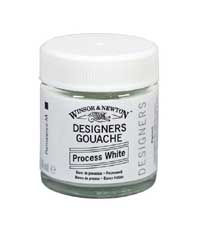 Body colour is the use of opaque colours for highlights or dense flat areas and is a technique which has been used in water colour for centuries. Designers Gouache was introduced in 1937 and prior to this the only method of achieving opacity was to use white, on its own or to make tints of the water colours. Body colour therefore refers to either tubes of gouache or the finished effect of opacity on a picture whether white or coloured. Framing Gouache Paintings I have painted and sold a number of flower paintings using Winsor & Newton Designers Gouache, framing them in ornate frames with a linen inset. However, I have now been told that gouache works should not be directly under glass but require a card mount between the glass and the painting. The frames are much more attractive than card mounts but should I stop using them? Related to this, about 10 years ago I painted a picture of deep purple buddleia, which has been hanging in a north facing room with no direct sunlight. I used Permanent White as a base, then Light Purple and Parma Violet. I have noticed that the dark shading is beginning to fade and wondered if this is because of the frame? Gouache and all works on paper should not be placed in a frame directly onto the glass, as this does not allow for any circulation within the frame and condensation can build up, resulting in mold growth. A mount between the paper and glass allows just enough circulation to prevent this. Provided your linen inset is between the paper and the glass, it will perform exactly the same job as a card mount. The frame will not have any effect on the fading of the painting you describe. The fading of a colour is due to the pigment and the methods which are used in painting. The permanence of a colour is described by Winsor & Newton using the system of AA, A, B and C. AA being Extremely Permanent and C being Fugitive. Fugitive means transient, some fugitive colours may fade within months. For permanent paintings it is recommended that only AA and A colours are used as these are not expected to fade. Light Purple has a B rating and Parma Violet a C rating, fading over a 10 year period would not be unexpected with these colours. Gouache Cracking I have been using gouache for posters and design work for many years. Recently, on nearly completing a picture with a black cat I found to my horror the Lamp Black had cracked. Fortunately, as the piece was on board I was able to remove the layer and repeat it without cracking. Do you think there is something missing from the Lamp Black, I have never had this problem before, I usually use Jet Black but the shop was out of stock. Winsor & Newton gouache derives its opacity and matt finish from the exceedingly high level of pigment used in the formulation. With so much pigment this means the proportion of binder (gum arabic) is lower than it would be in water colour. Cracking can usually be attributed to one of two reasons when using gouache. Firstly if not enough water is used to dilute the colour, the thicker film may crack as the paint dries on the paper. The amount of water needed will differ with each colour. Secondly, if painting in layers, the subsequent ones may show cracking if the underlayer absorbs binder from the wet colour. From your description, you could have suffered from either problem. I am sure there is nothing wrong with the Lamp Black, as this could have happened with any colour in the circumstances described. One final note for gouache painters, although not enough water can cause cracking using too much will over thin the colour leaving it dusty on the surface. You will need to learn what the right amount is with different colours as you use them. As a guide, if you do not use enough water, the colour will lack flow, if you use too much the colour will become more transparent and streaky. Permanence Of Gouache As I sometimes sell my gouache illustrations, I need to be sure the colours will not fade. Is permanence affected by dilution? I tend to put my colours on quite thin. Although thin washes will be more sensitive to light than thicker ones, gouache colours tend to be either lightfast or fugitive, in which case the amount of dilution doesn't really matter. Use only colours rated AA or A for permanence. This cuts out all the violets in gouache, for this area use Artists Water Colour instead. Preventing Lifting Of Gouache Colours I have been really enjoying using gouache with water colour and also mixed with pastels and acrylics. If I spend a long time on a picture, especially when mixing the paints on the same work, I find the gouache layers lift. I do not want to mix them with acrylic colours because then they are not the same. Water resistance can be achieved by adding small amounts of Acrylic Matt Medium. Experiment with a few colours so you can find the lowest level of medium required. The less acrylic in the gouache, the more like gouache it will remain. Care should be taken however as some colours can react. The pinks and violets in Designers Gouache can have a tendency to change colour on combination with acrylic. Some other Designers colours may be sensitive to alkali and produce gelatinous or lumpy mixtures. This reaction will be self evident whilst mixing on the palette. The addition of the medium will also deepen the tones and reduce the matt finish of the gouache colour. Priming For Gouache I have been painting with gouache onto hardboard, which I have primed with a household vinyl emulsion. I have been told that an artists Acrylic Gesso Primer is more appropriate but I cannot see the problem with what I am using at the moment. 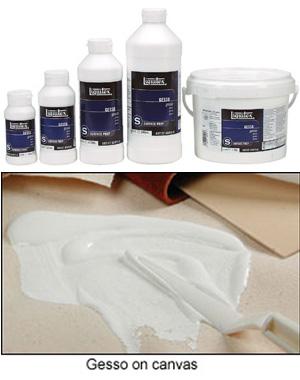 In years past the relationship between household paints and artists colours was much closer, as the raw materials used by both industries were in common. As new materials have been developed in their thousands the products for these two sectors have moved further and further apart. Nowadays the type and quality of the raw materials as well as the purposes and manner in which they are used has resulted in household paints performing a totally different job to the requirements of an artist. As a result of this, a household vinyl emulsion could not be expected to have the correct degree of absorbency required for an artists primer. Gouache is particularly susceptible to absorbent grounds as there is a low level of binder in order to achieve mattness and opacity. An over absorbent ground can lead to an underbound paint film and the pigment being insufficiently attached to the support. Household paint film is neither formulated to remain stable in the long term and can be expected to embrittle, discolour, crack and peel over a number of years. The resin and formulation used in Winsor & Newton Acrylic Gesso Primer ensure the correct absorbency and film stability expected for permanent works of art. Smooth Finishes With Gouache Some gouache colours seem to go on more smoothly than others. Is this to do with the pigments they contain or do different makes vary in consistency? Different makes vary a lot in consistency, the cheaper makes particularly suffer from a lack of flow and opacity. The pigments themselves will however have an affect. Within Winsor & Newton, colours rated T for transparency on the colour chart will not make as smooth a wash as those rated opaque. Thickening Gouache  Is there a medium you can mix with gouache to make it thicker? Occasionally I like a slight impasto would I be better off using acrylic? Aquapasto can be mixed with gouache to allow it to be used in thicker films. This is relative of course and even thick gouache cannot really be classed as impasto. Acrylic straight from the tube will be thicker than gouache and has the advantage of more than a dozen thickening and texturing mediums to further manipulate it. Whites In The Gouache Range I am told that there are various whites available in gouache, but so far I have managed quite well with only one. What are these other whites and what are they for? Permanent White is the whitest most opaque white but is not recommended for colour mixing. Zinc White produces the cleanest, most lightfast tints. And finally, Process White is for photographic retouching, where it will reproduce its true value. |


Dodgson Fine Arts Limited
Registered in Cardiff: No. 2790288
 |  |  |  |  |
 |  |  |  |  |
 |  |  |  |  |
 |  |  |  |  |
 Home |
Back to Hints and Tips Index page
For further information and help
please telephone 01524 68014 between 9 am and 5 pm Monday - Saturday
or email help@studioartshop.co.uk
Registered Office:
50 North Road Lancaster England LA1 1LT
Tel: +44 (0)1524 68014
VAT No. 155 6324 65
Copyright © Studio Arts. All Rights Reserved.