
|
Porcelaine
Paint Information Hints and Tips |

|
|
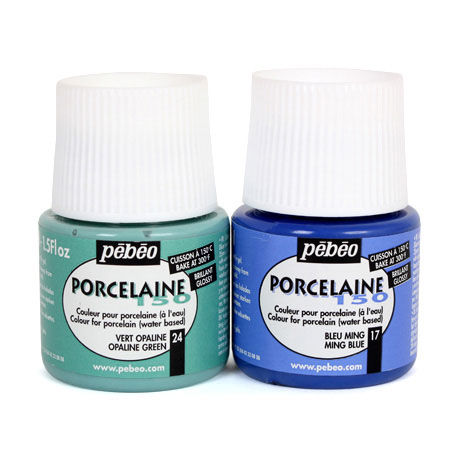 |
Pebeo Porcelaine 150 Ceramic Paint 45 ml Tubs,
Special offers and Prices
|
Porcelaine 150 can be
applied to all heat-stable bases that are able
to withstand a temperature of 150°C (300°F),
such as porcelain, china, glazed earthenware,
terracotta, metal, enamelled sheet steel, copper
and glass.
Colours can be fluidized
with the Porcelaine 150 thinner and are
available in bottle, tube or marker, which can
be mixed together, deep and glossy, transparent
or opaque, with a superb enamelled appearance
after baking. To produce a matt
finish, add a few drops of matt medium to the
colour before application. The gloss medium can
be used to lighten colours without thinning them
Excellent light stability. Cleaning
of brushes is with soapy water.
Drying is tack free in a few minutes, fully dry
in a minimum of 24 hours.
Baking of
all colours and auxiliary products in the range
takes 35 minutes at 150°C (300°F) in domestic
oven, after minimum 24 hours drying.
All colours and auxiliary products in the range
have remarkable resistance to dishwashing and to
normal detergents after baking. Manufacturer:
Pebeo
|
|
|
Click here to Buy Pebeo Porcelaine 150 Ceramic Paints Pens and Cloisonné
Outliners
Creative Ideas from
Pebeo
|
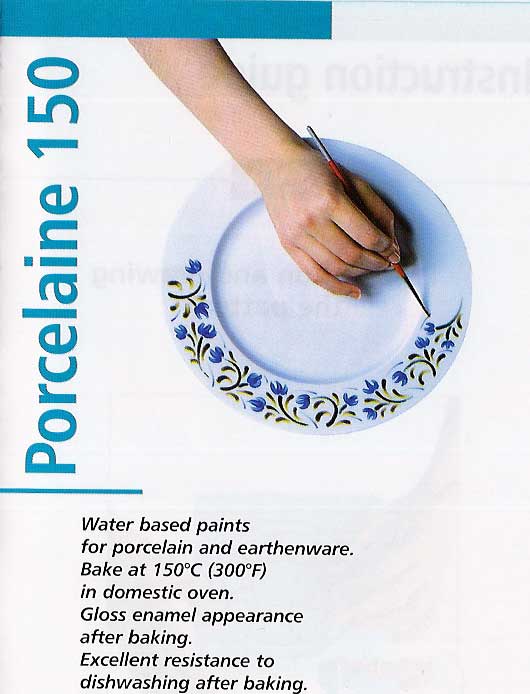
Porcelaine 150
can be applied to all heat-stable bases that are able to withstand a temperature
of 150°C (300°F) in a domestic oven, such as porcelain, china, glazed
earthenware, terracotta, metal, enamelled sheet steel, copper and glass.
Colours can be fluidized with the Porcelaine 150 thinner and are available in
bottle, tube or marker, which can be
mixed together, deep and glossy, transparent or opaque, with a superb
enamelled appearance after baking
To produce a matt finish, add a few drops of matt medium to the colour before
application. The gloss medium can be used to lighten colours without thinning
them
Excellent light stability.
Cleaning of
brushes is with soapy water.
Drying is tack free in a few minutes, fully dry in a minimum of 24 hours.
Baking of all colours and auxiliary products in the range takes 35 minutes at
150°C (300°F) in domestic oven, after minimum 24 hours drying.
All colours and auxiliary products in the range have remarkable resistance to
dishwashing and to normal detergents after baking.
Store the markers horizontal flat.
Conforms to toy safety standard 71.3.
Many applications are possible with Porcelaine 150 with brushes and also with
>
sponge, stencil... The Porcelaine 150 outliners, in tube with nozzle, can be
used for outlining work. The markers are recommended for lines and writing.
The colours are applied directly to a perfectly degreased base with alcohol or
soapy water. After observing the required drying time (minimum 24 hours), place
the decorated object in a cold oven. When the temperature of the oven has
reached 150°C (300°F), bake for 35 minutes. Colours have then a real enamelled
look and resist dishwashing. Manufacturer: Pebeo Ref 3214
Other sizes are available mail order please telephone 01524 68014 for more
information
On which surface can Porcelaine 150 be applied ?
The colours are particularly recommended on porcelain, china and glazed
earthenware, but numerous effects can be produced with other supports that are
able to withstand a temperature of 150°C (300°F) such as metal or glass...
How to prepare the surface to be painted ?
Simply clean thoroughly the surface with soapy water or alcohol.
Can I paint with Porcelaine 150 on porous objects, such as plaster or
earthenware ?
Yes, it is possible to paint on slightly porous objects. After a light
sanding, apply a coat of filler undercoat. Allow to dry for 24 hours, then apply
the paint.
How can I correct an error?
Before baking, it is very simple. The colours can be removed with water or
alcohol: use a damp cotton swab to correct a detail or soak your object in water
for a few minutes to erase everything.
Why did the colours brown after baking ?
The baking time was too long or the oven temperature was too high: use a
special thermometer available from Pébéo (available in the Porcelaine 150
range).
How can I obtain very transparent colours ?
Mix them with the gloss medium. Do not exceed 1/3 of medium for 2/3 of paint,
however.
What is the matt medium for ?
To obtain a matt appearance ; simply mix it with the paint.
How can I dilute the paints, fluidize them ?
With the Porcelaine 150 thinner. Caution, do not use water which would
reduce the resistance to washing.
Why did the paints form bubbles after baking ?
You probably did not allow the paint to dry long enough before baking. The
surface may have been too porous.
The paints did not resist dishwashing very well. Why ?
There are several possible reasons: the surface was poorly degreased with
alcohol, the paints were diluted with water or perhaps the instructions
regarding the baking temperature or duration were not respected.
When using for the first time, how do I make the colour run down to the end
of the felt tip marker ?
Shake vigorously, then count 30 to 60 seconds, pressing evenly on the tip.
|
|
Click here to Buy Pebeo Porcelaine 150 Ceramic Paints Pens and Cloisonné
Outliners |
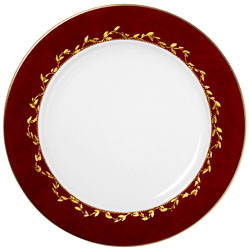
PURPLE AND
GOLD PLATE Creative Ideas from
Pebeo
Porcelaine 150 : Etruscan red 12.
 auxiliary
product :
Gold Porcelaine 150 outliner 07. auxiliary
product :
Gold Porcelaine 150 outliner 07.
accessory
: oven thermometer.
brush:
medium size foam brush.
a
white china plate. |
 Wash
your plate with soapy water to degrease it.
Wash
your plate with soapy water to degrease it.
Stir
the red paint and apply it, using a foam brush, on the rim of the
plate. If you are not satisfied with the result, you can always wash
your design before it dries.
Allow to dry for 24 hours, then draw free hand, directly with the
nozzle of the tube, a garland of small golden leaves.
Allow to dry for 24 hours. Then place your piece in a cold kitchen
oven. Set the temperature at 150°C or 300°F. Once the temperature
has been reached (use an oven thermometer to verify the
temperature), bake for 35 minutes. Then, turn off the oven, open the
door and allow to cool.
Once
baked, your plate will be dishwasher safe. |
|
 |
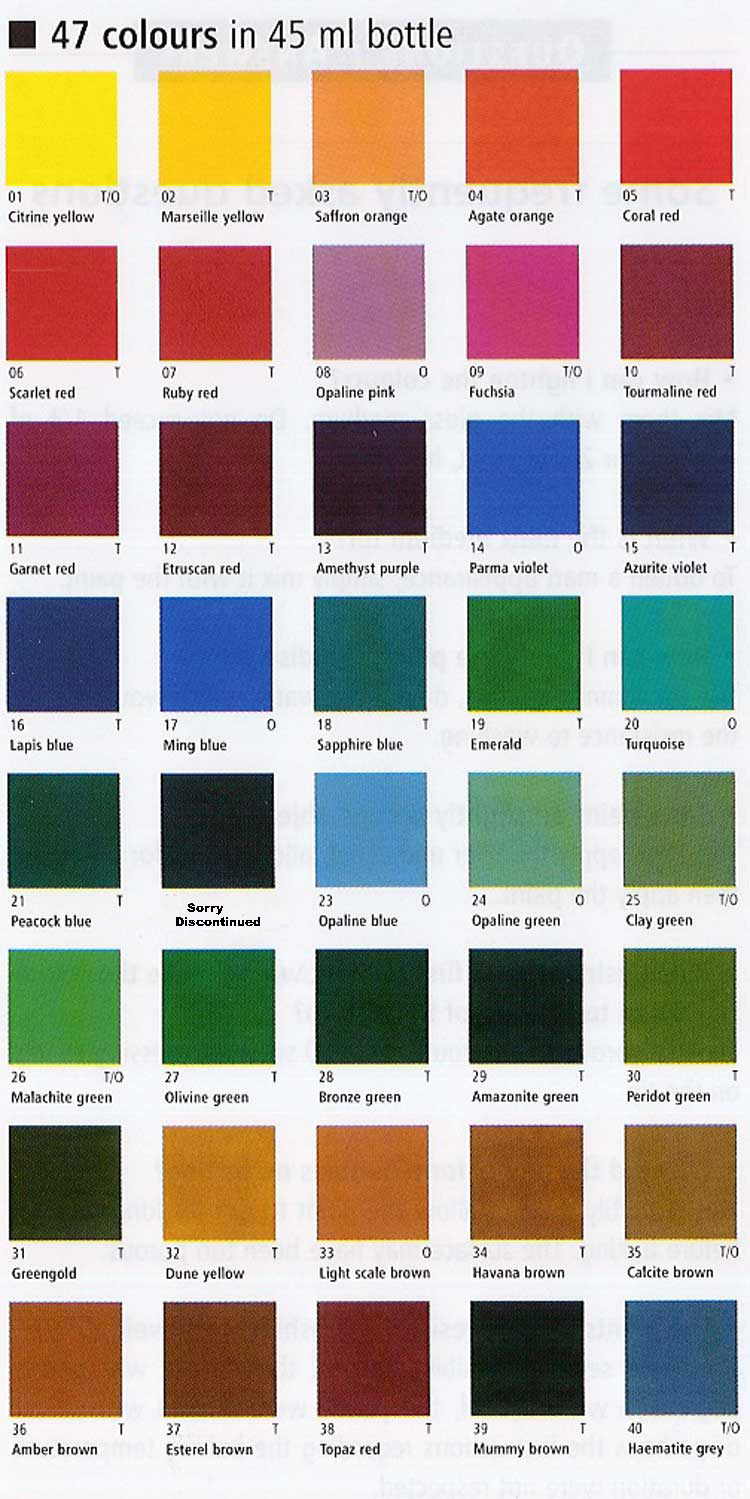
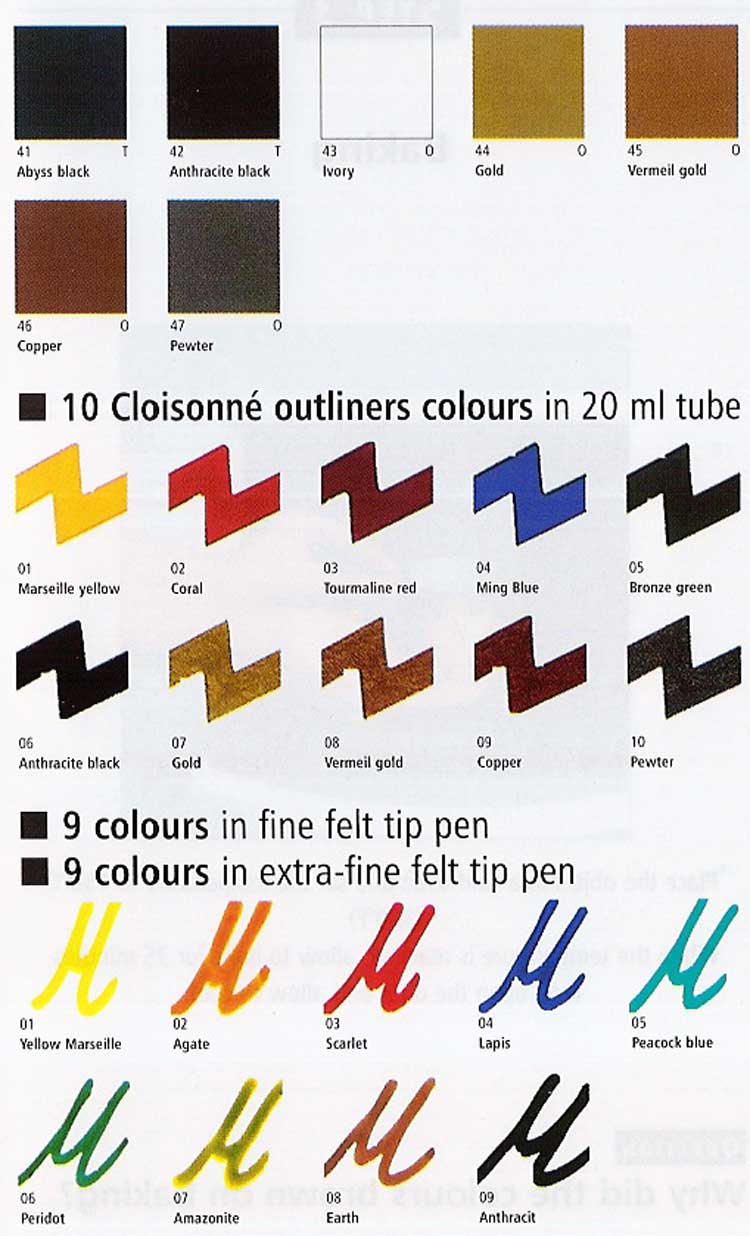
Porcelain 150 Ceramic Paints from Pebeo Scanned Colour Chart
47 colours, 10 cloisonne outliners, 9 fine tip pens, 9 large tip pens and 4
mediums thinners
T is transparent - T/O is
semi-transparent - O is opaque |
|
 |
|
 |
|
Extra fine felt tip is 1 mm and large is 2
mm approx. |
|
Studio Arts Shop for Online Discounts |
|
 |
|
Click here to Buy Pebeo Porcelaine 150 Ceramic Paints Pens and Cloisonné
Outliners |

Home
|
|
|
50 North Road Lancaster England
LA1 1LT
Tel: +44 (0)1524 68014
Copyright © Studio Arts. All
Rights Reserved. |
|